Full and Partial Dentures in Angier, NC: What to Expect, Step by Step
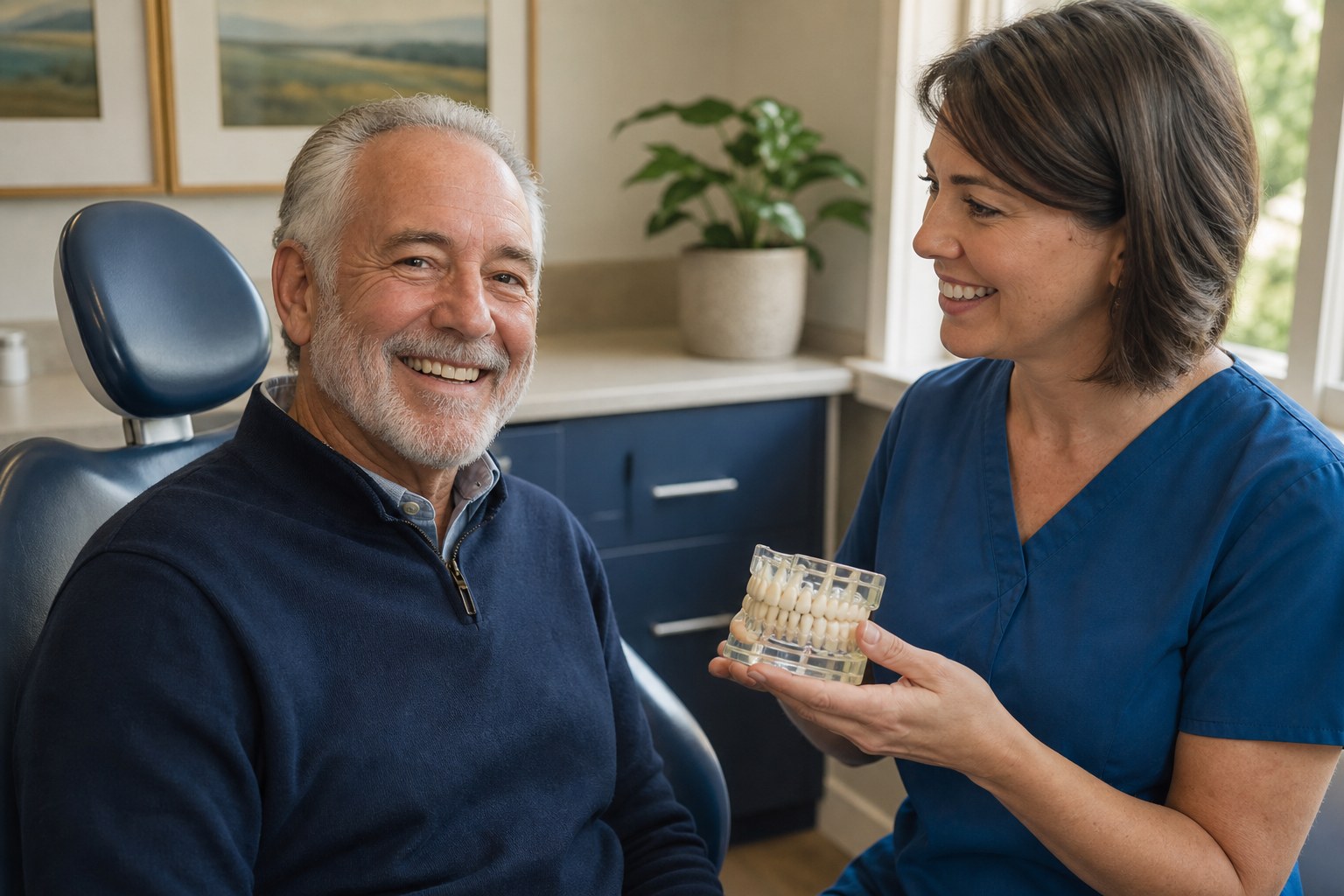
Missing several teeth, or wearing a denture that no longer fits? Dr. Brenda Gong walks Angier families through full and partial dentures — how the fitting process works visit by visit, what the first few weeks really feel like, how to care for them, and when an implant-retained option makes more sense.
Full Dentures vs. Partial Dentures: Which One Fits Your Situation?
If you've lost several teeth — or you're wearing a denture that no longer fits the way it once did — you're in far better company than you might think. Tooth loss is common, especially after years of managing a cracked molar or a tooth that finally gave out, and it's rarely anyone's fault. What matters now is getting back to eating, speaking, and smiling without thinking about it.
At Accent Family Dentistry on E Depot Street in Angier, Dr. Brenda Gong has fitted dentures for patients from Angier, Benson, Coats, and Lillington who came in convinced they'd just have to live with a gap. They didn't. A well-made denture is one of the oldest, most reliable solutions in dentistry, and today's versions are lighter, more natural-looking, and far better fitting than the ones your grandparents wore.
This is a plain-English walkthrough of what dentures actually involve — the difference between full and partial, how many visits it takes, what the first few weeks feel like, and when an implant-supported option is worth considering instead.
The right appliance depends entirely on how many healthy teeth you still have. Dr. Gong starts every conversation with an exam and X-rays, because saving a natural tooth — even one — usually gives you a better long-term result than removing it.
• Full dentures replace all the teeth on the upper arch, the lower arch, or both. They rest directly on the gums and are held in place by suction, the shape of your ridge, and a bit of practice.
• Partial dentures fill in one or more gaps while your remaining natural teeth stay put. They clasp discreetly onto neighboring teeth and also stop those teeth from drifting into the empty space.
• Immediate dentures go in the same day teeth are removed, so you're never without a smile. They need relining later as the gums heal and reshape.
• Implant-retained dentures snap onto two or more dental implants for dramatically better stability — the option most patients ask about once they hear it exists.
You can see how these compare on our dentures page, and if you're weighing stability above all else, our implants over dentures option is worth reading about before you decide.
The Fitting Process: Usually Four to Five Visits
Dentures aren't made in a single appointment, and that's a good thing — the extra steps are what produce a denture that actually fits. Here's the typical sequence at our Angier office:
• Visit one — exam and plan. Digital X-rays, a look at your gum health and bite, and an honest discussion of options and costs. If any teeth need to come out, we'll plan that too; simple removals are described on our teeth extractions page.
• Visit two — impressions. Precise molds of your ridges and bite so the lab can build to your anatomy, not an average.
• Visit three — the wax try-in. You'll see and wear a preview version. This is the moment to speak up about tooth shape, shade, and how much tooth shows when you smile. Changes here are easy; changes later are not.
• Visit four — delivery. Your finished denture is placed, adjusted, and checked while you bite, talk, and smile.
• Follow-ups. One or two short adjustment visits in the first month to relieve any sore spots.
If teeth were extracted, healing usually adds a few weeks to the timeline. Dr. Gong will give you a realistic schedule at the first visit rather than a best-case guess.
The First Few Weeks: What's Normal and What Isn't
Almost everyone needs an adjustment period. New dentures feel bulky at first, saliva increases for a few days, and certain words take practice. All of that fades — usually within two to four weeks.
A few things make it go faster. Start with soft foods and cut them small. Chew on both sides at once instead of biting straight down with your front teeth. Read out loud for ten minutes a day; it retrains your tongue faster than anything else. And take the denture out at night so your gums get a rest.
What isn't normal: a persistent sore spot that doesn't settle within a week, a denture that clicks or drops when you talk, or pain when you chew soft food. Those are fit issues, and they're fixable with a quick adjustment. Please call us at 919-639-3911 rather than reaching for drugstore adhesive to mask the problem — adhesive can hide a fit issue that's quietly irritating your gums.
Caring for Your Dentures So They Last
With reasonable care, a well-made denture typically lasts five to ten years before it needs relining or replacing. Your gums and jawbone slowly change shape after tooth loss, which is why even a perfect denture eventually needs refitting — that's the appliance doing its job, not failing.
• Rinse and brush daily with a soft denture brush and a non-abrasive cleaner. Regular toothpaste is too gritty and will dull the surface over time.
• Clean over a folded towel or a full sink. Dentures crack easily on a hard bathroom floor.
• Soak overnight in water or a denture solution — never hot water, which can warp the fit permanently.
• Keep brushing your mouth. Gums, tongue, palate, and any remaining natural teeth still need daily care.
• Keep your checkups. We check the fit, examine your gums, and screen for oral cancer at every visit — screenings matter just as much for denture wearers as for anyone else.
Comfortable, Straightforward Denture Care in Angier
Accent Family Dentistry is a family-owned, independent practice, and that shapes how we handle treatment like this. There's no pressure toward the most expensive option — Dr. Gong will lay out what a traditional denture, a partial, and an implant-retained denture each cost and each require, and then help you pick the one that fits your mouth and your budget.
If dental visits make you tense, tell us before we begin. Many patients who put off replacing missing teeth for years did so out of anxiety, not indifference, and we take that seriously — gentle pacing, clear explanations, and sedation options are all available. Members of our team are bilingual in English and Spanish, so Spanish-speaking families are welcome here.
We see patients from Angier, Fuquay-Varina, Apex, Holly Springs, Willow Spring, Lillington, Coats, and Benson. Call 919-639-3911 or request an appointment online — we're open Monday through Thursday, 9:00 AM to 6:30 PM. If you've been eating around a missing tooth or hiding a gap when you smile, one conversation is enough to find out what your options really are.
Ready to schedule an appointment?
Call Accent Family Dentistry in Angier, NC at 919-639-3911 or use our online scheduler.
Schedule OnlineQuestions About Your Dental Health?
Dr. Gong and her team are always happy to answer your questions and help you understand your treatment options.